
Europe’s New Carbon Wall: Vietnam at the CBAM Threshold – Opportunity or Market Exclusion?
On April 7, 2026, the European Commission published the first official CBAM certificate price in history: €75.36 per tonne of CO₂. For Vietnam – with approximately USD 50 billion in annual exports to the EU – this marks a fundamental shift in trade competitiveness. This paper quantifies CBAM’s financial impact sector by sector, evaluates the geopolitical landscape of likely EU policy trajectories, and develops strategic scenarios for how Vietnam might respond. It concludes with concrete, time-sensitive recommendations for manufacturers, sector regulators, and the Vietnamese government.
CONTEXT: CBAM AND THE RESHAPING OF GLOBAL TRADE ARCHITECTURE
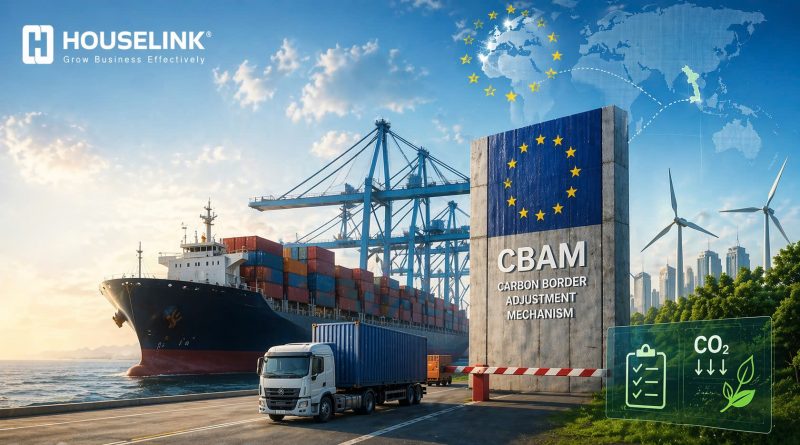
January 1, 2026 marks an inflection point in the history of international trade. For the first time, goods imported into the European Union must bear a carbon cost equivalent to that paid by EU producers under the Emissions Trading System (EU ETS). The Carbon Border Adjustment Mechanism (CBAM), established by Regulation (EU) 2023/956, is not a conventional import duty. It is a new instrument of climate-based trade policy – one designed to export the EU’s carbon price to the rest of the world.
The official Q1/2026 CBAM certificate price of €75.36/tCO₂, published April 7, 2026, is the legal price applied to every import shipment in six sectors: iron & steel, aluminium, cement, fertilisers, hydrogen, and electricity. This is not a forecast or estimate – it is a binding financial obligation, calculated as the volume-weighted average of EU ETS auction clearing prices [9].
The Structural Disadvantages Facing Vietnam
Vietnam faces two compounding structural disadvantages under CBAM. First, the country has no effective carbon price recognised by the EU to offset CBAM liability. While Vietnam launched its pilot ETS in August 2025 under Decree 119/2025/ND-CP, allowances are distributed for free during the pilot phase (2025–2028) – meaning no verified carbon cost exists to deduct. The EU Commission’s formal rules on third-country carbon price recognition are themselves still under development (Call for Evidence, August 2025) [8].
Second, Vietnam’s grid emission factor – officially confirmed at 0.66 kgCO₂/kWh for 2023 [1] (Ministry of Climate Change, December 2024) – is three times the EU average of 0.22 kgCO₂/kWh. By 2024, this figure had risen to an estimated 0.681 kgCO₂/kWh [2] as coal-fired electricity output surged 17.7%. This makes Vietnam’s EAF steelmakers and aluminium smelters carry a heavier Scope 2 carbon burden than technically identical operations in Europe or South Korea.
Steel: Technology-Dependent Divergence
BF-BOF steel faces the starkest trajectory. Current cycle EBITDA margins of €32–65/tonne [4] will be exceeded by CBAM costs alone in 2030 (~€133.8/t) – by a factor of 2–4x. By 2034, CBAM represents 50–63% of HRC selling price (~€545–682/t). The economics of EU-directed BF-BOF exports collapse well before full phase-in.
EAF steel carries a specific Vietnamese disadvantage: the high grid emission factor (0.66 kgCO₂/kWh) makes Scope 2 emissions for Vietnamese EAF (~0.30 tCO₂/t from electricity alone) roughly 7.5 times higher than EAF using renewable power (~0.04 tCO₂/t). A DPPA contract with a renewable energy plant addresses this at near-zero incremental cost, cutting 2030 CBAM from ~€78/t to ~€28/t – the highest-leverage action available to EAF steelmakers today.
Aluminium Smelting: The Most Vulnerable Sector
Coal-grid primary aluminium smelting faces existential CBAM exposure. The updated emission intensity (~12–15 tCO₂/t using the official 0.66 kgCO₂/kWh grid factor) implies 2034 CBAM costs of ~€2,100/tonne – approaching the full selling price of aluminium ingot (~€2,100–2,300/t). There is no economically viable path for coal-grid primary aluminium exports to the EU beyond 2030. Transition to secondary (recycled) aluminium or renewable-powered smelting is the only long-term strategy.
MULTI-DIMENSIONAL ASSESSMENT: CBAM IN THE GEOPOLITICAL CONTEXT
Is the EU Isolating Itself?
With EU ETS at €73–74/tCO₂ [5] versus South Korea’s K-ETS at ~€6/tCO₂ and China’s CN-ETS at ~€8.7/tCO₂ [5] – a 10–12x differential – the question of EU self-isolation is legitimate and increasingly debated within Europe itself. The reality is more nuanced than a simple ‘yes’ or ‘no’.
CBAM is not merely an environmental policy – it is a geopolitical instrument designed to extend the EU’s carbon price to global trade flows. But the strategy faces mounting internal contradictions: German deindustrialisation (negative GDP growth 2023–2024), the political rise of parties explicitly opposing ‘green taxes’ across multiple member states, and the competitive asymmetry created by the United States maintaining no federal carbon price under the Trump administration. The EU’s ‘Omnibus Simplification’ package (Regulation (EU) 2025/2083, effective October 2025) – which reduced CBAM administrative thresholds and simplified compliance – is the first visible sign of policy softening.
The Real Competitive Picture: Corrected with ICAP Data
The corrected data reveals a critical insight: the competitive advantage that South Korea might gain over Vietnam from K-ETS recognition is only ~€6/tonne of steel. At current low K-ETS prices, the carbon pricing differential between countries is relatively modest. The more decisive competitive variable is actual production emission intensity – and this is where Vietnam can act fastest, through DPPA renewable energy contracts.
Geopolitical Turbulence as Double-Edged Sword for Vietnam
The same geopolitical turbulence that creates CBAM uncertainty – US-China trade competition, Middle East conflict, Ukraine war – also creates strategic opportunity. The ‘China+1’ supply chain diversification drive is bringing unprecedented manufacturing FDI to Southeast Asia. Vietnam is a prime destination – but only for manufacturers requiring verifiable ESG and carbon compliance credentials. Apple, Samsung, BMW, and Volkswagen all mandate PCF data from Tier-1 and Tier-2 suppliers, independently of CBAM. If Vietnam builds carbon data infrastructure first among ASEAN peers, it captures this wave. If not, Thailand, Malaysia, or Indonesia will.
STRATEGIC RECOMMENDATIONS FOR MANUFACTURING COMPANIES
Priority #1: Establish MRV and PCF Measurement Infrastructure in 2026
Companies without verified emissions data will be assigned Default Values under IR (EU) 2025/2621 [6] – set at the highest emission intensity observed globally for their product category. The cost of establishing an IoT + ISO 14067 PCF measurement system: $15,000–50,000. The cost of bearing default-rate CBAM liability for even one mid-sized export shipment by 2028: $100,000–500,000+/year. The economics of early action are unambiguous.
Priority #2: DPPA Renewable Energy – Highest Leverage, Lowest Cost
With Vietnam’s grid at 0.66 kgCO₂/kWh and rising, DPPA renewable power contracts represent the highest-impact, lowest-cost decarbonization action available. For EAF steelmakers, DPPA cuts 2030 CBAM from ~€78/t to ~€28/t. In many central and southern provinces, DPPA solar rates are at or below grid tariffs. There is no economic argument for delay.
Priority #3: Third-Party Verification Before EU Importers Demand It
EU importers must surrender CBAM certificates for 2026 imports by September 30, 2027 [7]. Vietnamese exporters need LRQA/TÜV/Bureau Veritas-verified emissions data before that deadline. Initiate the accreditation process by Q3/2026 – leave at least 9 months for the verification cycle.
At €75.36/tCO₂ and rising toward 100% phase-in by 2034, CBAM represents an irreversible shift in the terms of access to the EU’s €14 trillion economy. But it is not an insurmountable wall – it is a new measure of global competitiveness. Companies that measure, verify, and reduce their emissions before the obligation bites will have lower costs and stronger customer relationships. Those that wait will pay for the same compliance at a multiple of the current price.
The most probable scenario (38%) is that the EU will adjust CBAM’s pace under political pressure. This may create a false sense of security for Vietnamese manufacturers. The real danger is not CBAM proceeding on schedule – it is that competitors in Thailand, Malaysia, and Indonesia build carbon data infrastructure while Vietnam waits. By the time urgency is undeniable, the compliance window will already be expensive.
The 2026–2028 window – when the CBAM factor is just 2.5–10% – is the only period in which preparation is affordable relative to the obligation avoided. The choice is not ‘comply or not comply.’ It is ‘comply early and gain competitive advantage, or comply late and pay a multiple.
Source:HOUSELINK